
CO2 / N2O filling ratio calculator: how much may go into your cylinder?
Maximum fill mass = mass of the water the cylinder holds × filling ratio. The filling ratio depends on the test pressure PH stamped on the shoulder and is set in the ADR (packing instruction P200): for CO2 0.68 from 190 bar and 0.76 from 250 bar test pressure.
Calculate the fill mass
Maximum fill mass CO2
7.59 kg
10 L of water (9.99 kg) × 0.76
Full cylinder at most: – kg, plus valve and cap
The rule: higher test pressure, higher filling ratio
- Test pressure from190 bar0.68your cylinder
- Test pressure from250 bar0.76your cylinder
- Test pressure from180 bar0.68your cylinder
- Test pressure from225 bar0.74your cylinder
- Test pressure from250 bar0.75your cylinder
P200 (5)(b): at 65 °C the pressure must not exceed the test pressure. Liquid CO2 and N2O expand strongly when warmed, so a cylinder with a lower test pressure may hold less.
Please enter values within the stated range.
Cylinders for this
Filled cylinders shipped from our warehouse in Poland, buyable online.
2 kg CO₂ cylinder
The 2 kg CO₂ cylinder with filling
- Food-grade CO₂ (E290), 2 kg in a 2.7 L steel cylinder
- Standard W21.8 valve: fits regulators, beer taps and, with our adapter kit, SodaStream Quick Connect machines (Terra, DUO, Art)
- Refill by post through our refill service
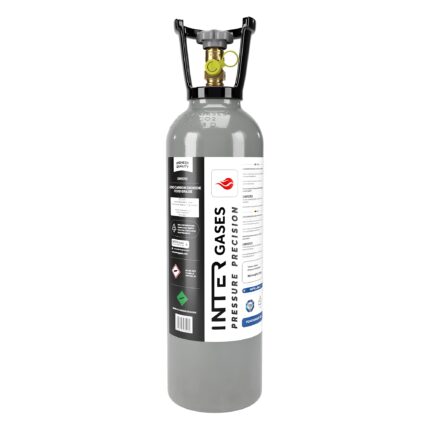 3.75 kg CylinderCO2 E290 Food GradeView product →
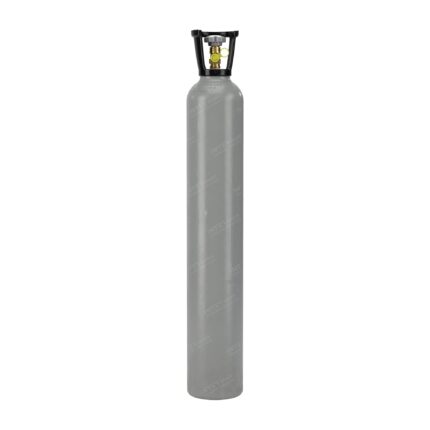 7.5 kg CylinderCO2 E290 Food GradeView product →
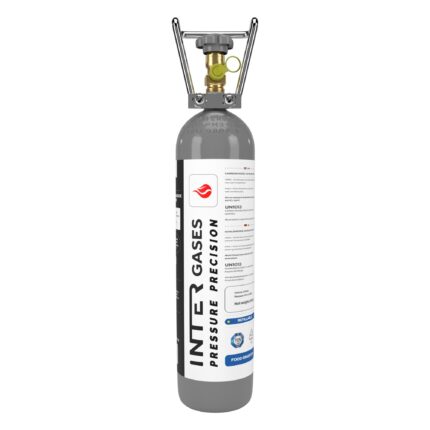 CO2 Cylinder RefillView product →CO2All sizes in the shopAll sizes →N2OAll sizes in the shopAll sizes →
Shop by use: CO2 cylinder for beer taps · CO2 cylinder for SodaStream · CO2 cylinder for aquariums
How to read the shoulder stamp
Tap a marking to see what it means. The example is the shoulder of a 10 kg CO2 cylinder with 13.4 litres water capacity. Position and layout vary by manufacturer and year.


Test pressure
300 bar is the pressure the cylinder was tested at (ADR 6.2.2.7.3 f). The ADR table takes the highest row this reaches: from 250 bar, 0.76 kg/L. So the cylinder may hold at most 13.4 L × 0.76 ≈ 10.2 kg of CO2.
- INTERGASES · Owner’s mark
- The name of the cylinder’s owner, here Intergases. The filling station can see whose cylinder it is.
- 18.6KG · Empty mass
- 18.6 kg is the empty cylinder without valve and cap (ADR 6.2.2.7.3 g). A full cylinder weighs this plus the gas plus the valve.
- 13.4L · Water capacity
- 13.4 litres of water would fill the cylinder (ADR 6.2.2.7.3 j). The calculator multiplies this figure by the filling ratio.
- 03/25 · Initial inspection
- March 2025, the date of the initial inspection (ADR 6.2.2.7.2 e). The ADR format is year/month, i.e. 2025/03; this example uses the short form 03/25. P200 sets a 10-year test period for CO2, so this cylinder is next due in March 2035.
- ISO · Design standard
- The standard the cylinder was designed, made and tested to (ADR 6.2.2.7.2 b). On seamless steel cylinders it is usually ISO 9809-1.
- CO2 · Gas
- The gas the cylinder is set up for, carbon dioxide. CO2 is filled by weight, so the filling ratio sets the limit.
- 25E · Neck thread
- 25E is the taper neck thread with a nominal diameter of 25.8 mm (EN ISO 11363-1). The valve needs the same thread.
- PW200 · Working pressure
- 200 bar at 15 °C, the limit for compressed gases such as argon or nitrogen. For CO2 it plays no part: what counts is the mass, set by the test pressure.
- PH300 · Test pressure
- 300 bar is the pressure the cylinder was tested at (ADR 6.2.2.7.3 f). The ADR table takes the highest row this reaches: from 250 bar, 0.76 kg/L. So the cylinder may hold at most 13.4 L × 0.76 ≈ 10.2 kg of CO2.
- π0036 · π mark and notified body
- The π mark shows that the cylinder meets the EU directive on transportable pressure equipment (2010/35/EU). 0036 is the number of the notified body that inspected it.
Why a CO2 cylinder is never filled to the top
The chart shows the vapour pressure of CO2 and the pressure in a filled cylinder as it warms up. While liquid and gas share the cylinder, the pressure follows the vapour-pressure curve. Once the liquid fills the cylinder completely, the pressure climbs steeply.

How we calculate
- The ADR (1.2.1) defines the filling ratio as the mass of gas divided by the mass of water at 15 °C that would completely fill the cylinder. One litre of water weighs 0.9991 kg at 15 °C.
- We take the table value for your test pressure (P200 Table 2). Between two rows the lower row applies; below the lowest row the table gives no value, and other pairs are permitted only where the 65 °C criterion of P200 (5)(b) is met.
- Maximum fill mass = water volume × 0.9991 kg/L × filling ratio.
- Full cylinder at most = stamped empty mass + maximum fill mass. The stamped mass excludes valve and cap (ADR 6.2.2.7.3 g).
The test pressure matters because CO2 has a critical temperature of 30.98 °C and N2O of 36.37 °C. Above it there is no liquid, and in a well-filled cylinder the pressure climbs steeply as it warms. The filling ratios in the table keep that rise within what the cylinder was tested for, so a higher test pressure allows a higher filling ratio.
Worked examples
| Cylinder | CO2, PH 190 bar | CO2, PH 250 bar |
|---|---|---|
| Water volume for 2.0 kg CO2 | at least 2.95 L | at least 2.64 L |
| 10 L | at most 6.79 kg | at most 7.59 kg |
| 50 L | at most 33.97 kg | at most 37.97 kg |
| Cylinder | N2O, PH 180 bar | N2O, PH 225 bar | N2O, PH 250 bar |
|---|---|---|---|
| 10 L | at most 6.79 kg | at most 7.39 kg | at most 7.49 kg |
| 50 L | at most 33.97 kg | at most 36.97 kg | at most 37.47 kg |
Sources: ADR 2025 (ECE/TRANS/352, applicable from 1 January 2025): 4.1.4.1, packing instruction P200 paragraph (5) and Table 2 (UN 1013, UN 1070); filling ratio 1.2.1; marking 6.2.2.7.2 and 6.2.2.7.3. Property data (critical temperatures, vapour pressures, density of water at 15 °C): CoolProp 8.0.0 (I. H. Bell et al., Ind. Eng. Chem. Res. 53 (2014) 2498–2508).
Frequently asked questions
On the cylinder shoulder. On UN pressure receptacles the test pressure is preceded by “PH” and followed by “BAR” and the empty mass is followed by “KG”; cylinders for liquefied gases also carry the water capacity followed by “L” (ADR 6.2.2.7.3).
At most 7.59 kg with a test pressure of 250 bar, at most 6.79 kg with 190 bar.
As long as there is liquid in the cylinder, the pressure sits at the vapour pressure, at 15 °C about 50 bar for CO2 and about 44 bar for N2O (CoolProp), whether the cylinder is full or nearly empty. Weigh it instead: gross mass minus the stamped empty mass and the valve.
The ADR sets that temperature in P200 paragraph (5). It applies to compressed gases such as argon too: their pressure at 65 °C must not exceed the test pressure either.
At most the stamped empty mass plus the maximum fill mass. The stamped mass excludes valve and cap (ADR 6.2.2.7.3 g), so weighed with its valve the cylinder is heavier by the valve’s weight.
Embed this calculator
You may embed the calculator in blogs, forums and guides for free, without signing up. Please keep the credit line.
Values are guidance. The cylinder’s markings and the ADR govern.


