Blog
What gas for MIG welding: CO2, Ar/CO2 82/18, 92/8 or Ar/O2
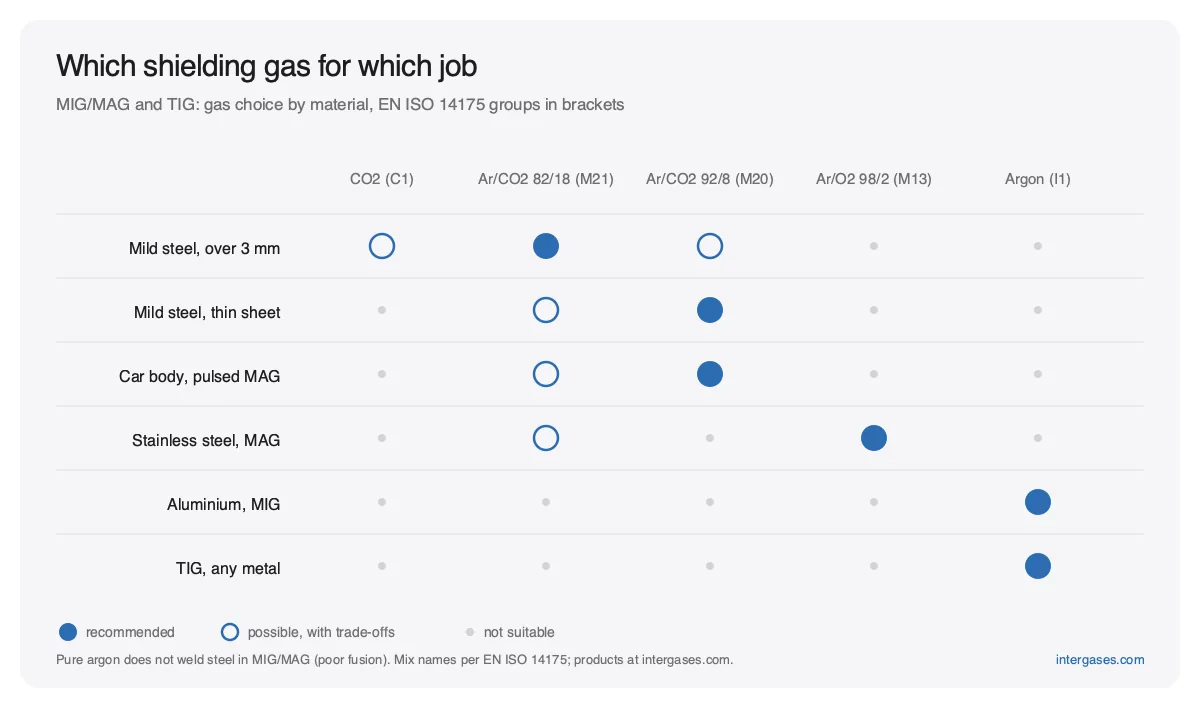
If you are asking what gas for MIG welding of ordinary steel, the short answer is an argon/CO2 mix of 82/18 (EN ISO 14175 code M21). It gives a stable arc, little spatter and enough penetration for most workshop jobs. Pure CO2 is cheaper per litre and welds steel well, with more spatter. For thin sheet, 92/8 (M20) runs cooler. Stainless steel takes argon with 2 % oxygen (M13), and aluminium takes pure argon.
Strictly speaking, MIG means an inert gas (argon) and MAG means an active gas (anything containing CO2 or O2). Most people say “MIG” for both, and so does this guide. Below you find the four common options, a decision table by material and thickness, and the arithmetic for how long a cylinder lasts.
The four MIG/MAG gases and their EN ISO 14175 names
EN ISO 14175 is the international standard, adopted in Europe, that classifies welding gases. You will see its codes on cylinder labels and in welding wire data sheets. Four codes cover almost everything a hobby or small workshop welder needs.
| Gas | EN ISO 14175 code | Best for |
|---|---|---|
| CO2 (100 %) | C1 | Mild steel over 3 mm where spatter clean-up is acceptable; lowest gas cost |
| Ar/CO2 82/18 | M21 | Carbon and low-alloy steel, all-round workshop gas, body shops, steel construction |
| Ar/CO2 92/8 | M20 | Thin sheet and pulsed welding; less spatter and less heat input |
| Ar/O2 98/2 | M13 | Spray-arc MAG welding of stainless steel; bright, well-wetted welds |
Pure argon (code I1) is the fifth gas in a welding shop, but it belongs to TIG welding and to MIG welding of aluminium, not to MIG welding of steel.
What gas for MIG welding mild steel, thin sheet, stainless and aluminium
Pick the row that matches the job you do most often. If you weld a mix of jobs, choose the gas for the most common one and accept a small compromise on the rest.
| Material and thickness | Recommended gas | Why |
|---|---|---|
| Mild steel over 3 mm | Ar/CO2 82/18 (M21), or CO2 if cost matters most | Good penetration; CO2 adds spatter |
| Thin sheet under 2 mm | Ar/CO2 92/8 (M20) or 82/18 | Lower heat input, less burn-through and distortion |
| Car body panels, pulsed MIG | Ar/CO2 92/8 (M20) | Smooth beads, little spatter on visible work |
| Stainless steel, spray arc | Ar/O2 98/2 (M13) | Low oxidation keeps the weld bright |
| Aluminium | Pure argon (I1) | Any CO2 or O2 would oxidise the weld pool |
For aluminium, the cylinder choice works like TIG: see our guide to argon cylinder sizes for TIG welding.
Spatter, penetration and heat input in plain words
Three things change when you move between CO2 and the argon mixes.
Spatter. CO2 makes the droplet transfer from the wire to the pool less regular. Droplets explode and land around the weld as small balls that you grind off later. A university study that varied CO2 from 2 % to 100 % in argon found less regular metal transfer and more spatter as the CO2 share rose.
Penetration. The same study found that more CO2 also gives deeper penetration and a larger fusion area. That is why pure CO2 still has a place on thick mild steel. An 82/18 mix sits in the middle: enough CO2 for good fusion, enough argon for a calm arc.
Heat input. Less CO2 means a cooler, softer arc. On 0.8–1.5 mm sheet that is what you want, because the panel burns through or warps less. On 10 mm plate you want the opposite.
Pure argon on steel is the one combination that does not work well. The arc wanders, the weld pool stays narrow and humped, and fusion at the edges is poor. A small active addition of CO2 or O2 fixes this, which is why every steel gas above contains one.
Why pure CO2 is the cheapest, and when that is fine
CO2 is stored as a liquid and filled by weight, so a small cylinder holds a lot of gas. One kilogram of CO2 gives about 0.54 m³ of gas at 1 bar and 15 °C. Our 6 kg CO2 cylinder (8 L, 149.99 €) therefore holds 6 × 0.54 = about 3.2 m³. An 8 L Ar/CO2 82/18 cylinder holds 1.9 m³ at 200 bar and costs 159.99 €.
| Cylinder | Gas | Price | Gas content | Price per m³ (first purchase) |
|---|---|---|---|---|
| 8 L | CO2 (6 kg) | 149.99 € | about 3.2 m³ | 149.99 ÷ 3.2 = 46.87 € |
| 8 L | Ar/CO2 82/18 | 159.99 € | 1.9 m³ | 159.99 ÷ 1.9 = 84.21 € |
| 10 L | Ar/CO2 82/18 | 169.99 € | 2.3 m³ | 169.99 ÷ 2.3 = 73.91 € |
| 20 L | Ar/CO2 82/18 | 249.99 € | 4.7 m³ | 249.99 ÷ 4.7 = 53.19 € |
The prices include the cylinder itself, which you keep, so later refills cost less per m³ than the first purchase.
Pure CO2 is fine when you weld mild steel of 3 mm and more, when the weld is hidden or painted, and when grinding off spatter costs you less than the price difference. Our CO2 is food grade (E290), and the 6 kg CO2 cylinder has the same W21.8 × 1/14″ valve as our argon and mix cylinders.
Flow rate and cylinder size: how long a cylinder lasts
A typical MIG flow rate on steel indoors is 10–15 L/min. Go higher in a draught or outdoors. Going far beyond about 20 L/min makes the gas stream turbulent and pulls in air. The arc time of a cylinder is the gas content divided by the flow rate:
arc time (hours) = m³ × 1,000 ÷ L/min ÷ 60
Two worked examples with Ar/CO2 82/18:
- 10 L cylinder, 2.3 m³ = 2,300 L. At 10 L/min: 2,300 ÷ 10 = 230 minutes, about 3.8 hours. At 15 L/min: 2,300 ÷ 15 = 153 minutes, about 2.6 hours.
- 20 L cylinder, 4.7 m³ = 4,700 L. At 10 L/min: 470 minutes, about 7.8 hours. At 15 L/min: 313 minutes, about 5.2 hours.
| Ar/CO2 82/18 cylinder | Gas content | Arc time at 10 L/min | Arc time at 15 L/min | Delivery |
|---|---|---|---|---|
| 5 L | 1.2 m³ | 2.0 h | 1.3 h | Parcel |
| 10 L | 2.3 m³ | 3.8 h | 2.6 h | UPS (ADR) |
| 20 L | 4.7 m³ | 7.8 h | 5.2 h | Truck (ADR) |
| 50 L | 11.7 m³ | 19.5 h | 13.0 h | Truck (ADR) |
This is pure arc time. Pre-flow, post-flow and test bursts use gas too, so real welding time is a little shorter. Arc time is also not workshop time: a hobby welder who strikes an arc for 20 minutes on a Saturday gets many weekends from a 10 L cylinder.
For a home workshop, the Ar/CO2 82/18 in a 10 L cylinder (169.99 €) is a practical size. For a shop that welds every day, the 20 L Ar/CO2 82/18 cylinder (249.99 €) halves the number of changes and costs less per m³. If you are unsure whether to own or rent, read buy or rent a gas cylinder.
Reading the cylinder: colour, label, valve and ownership
Before you connect a cylinder, check four things.
- Colour. Under EN 1089-3, argon and argon mixes (Ar/CO2, Ar/O2) have an emerald green shoulder (RAL 6001) and a grey body. CO2 cylinders are grey (RAL 7037). The colour is a guide; the label is binding.
- Label. The label names the gas or the mixture, the EN ISO 14175 code (for example M21) and the UN number: UN 1006 for argon, UN 1956 for compressed gas mixtures, UN 1013 for CO2.
- Valve. All refillable Intergases cylinders have a W21.8 × 1/14″ outlet (DIN 477 No. 6). It fits standard European CO2 and argon regulators; a regulator with a W21.8 × 1/14″ inlet connects without an adapter.
- Ownership. You buy the cylinder: no rent, no deposit. When it is empty, you refill or exchange it through our refill service.
For other mixtures, such as Ar/CO2 from 98/2 to 80/20 or three-component gases, see our welding gas mixes, and for older background read welding gas cylinders for TIG and MIG.
FAQ
Can I use pure argon for MIG welding steel?
No. Pure argon gives an unstable arc on steel, a narrow and shallow weld and poor fusion at the edges. Steel needs a small active share of CO2 or O2. Use Ar/CO2 82/18 for steel and keep pure argon for aluminium and TIG.
Can I use Ar/CO2 82/18 for stainless steel?
For solid stainless wire, choose Ar/O2 98/2 (M13) instead. Gas suppliers’ selection charts list low-CO2 or Ar/O2 gases for solid stainless wire, not 82/18. Some stainless flux-cored wires are made for M21, so check the wire data sheet.
What gas do I need for flux-cored wire?
Self-shielded flux-cored wire needs no gas at all. Gas-shielded flux-cored wire usually runs on CO2 or an Ar/CO2 mix such as 82/18. The wire packaging states which gas it was designed for.
Does the gas mix matter on a 150 A hobby machine?
Yes. On a small machine you mostly weld thin and medium steel, where an 82/18 mix gives less spatter and neater beads than pure CO2. If you weld mainly 3 mm and thicker and grinding is not a problem, CO2 saves money.