Blog
Argon cylinder sizes for TIG welding: 5, 10, 20 and 50 L, how long each lasts, and 4.8 vs 5.0
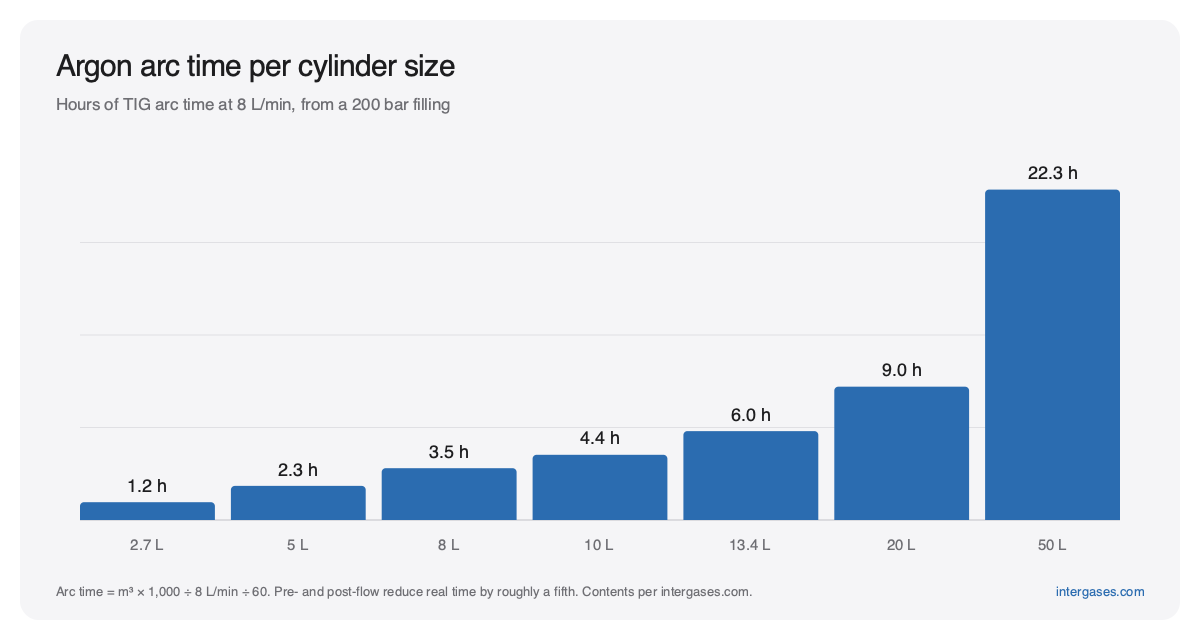
Argon cylinder sizes run from 2.7 L to 50 L of water capacity. At 200 bar a 5 L cylinder holds 1.1 m³ of argon, a 10 L cylinder 2.1 m³, a 20 L cylinder 4.3 m³ and a 50 L cylinder 10.7 m³. At a TIG flow of 8 L/min that is about 2.3, 4.4, 9 and 22 hours of gas flow. For a home or hobby workshop a 10 L cylinder is the usual choice; for daily work a 20 L cylinder. Argon 4.8 is enough for TIG welding, but at Intergases 4.8 and 5.0 cost the same, so take 5.0.
Argon cylinder sizes and gas content at 200 bar
The size of a gas cylinder is its water capacity in litres, not the amount of gas inside. Argon is a compressed gas, so the content depends on fill pressure. The figures below are for a fill pressure of 200 bar. The table gives the gas content in cubic metres at 1 bar and 15 °C, how the cylinder is delivered, and the listed price for Argon 5.0.
| Cylinder | Argon at 200 bar | Delivery | Price (Argon 5.0) |
|---|---|---|---|
| 2.7 L | 0.6 m³ | Parcel | 79.99 € |
| 5 L | 1.1 m³ | Parcel | 109.99 € |
| 8 L | 1.7 m³ | Parcel | 169.99 € |
| 10 L | 2.1 m³ | UPS (ADR) | 179.99 € |
| 13.4 L | 2.9 m³ | UPS (ADR) | 199.99 € |
| 20 L | 4.3 m³ | Truck (ADR) | see shop |
| 27 L | 5.8 m³ | Truck (ADR) | see shop |
| 30 L | 6.4 m³ | Truck (ADR) | see shop |
| 40 L | 8.5 m³ | Truck (ADR) | see shop |
| 50 L | 10.7 m³ | Truck (ADR) | see shop |
Prices include VAT. Cylinders up to 8 L travel as ordinary parcels. The 10 to 13.4 L sizes go with UPS as dangerous goods under ADR. From 20 L upwards, delivery is by truck freight.
A useful number from the table is the price per cubic metre on first purchase. For the 10 L cylinder: 179.99 € ÷ 2.1 m³ = about 85.70 € per m³. For the 5 L cylinder: 109.99 € ÷ 1.1 m³ = about 100 € per m³.
How long does an argon cylinder last?
The run time of an argon cylinder follows from one formula:
hours of flow = m³ × 1,000 ÷ flow rate (L/min) ÷ 60
Example for a 10 L cylinder at 8 L/min: 2.1 m³ = 2,100 L; 2,100 ÷ 8 = 262 minutes; 262 ÷ 60 = 4.4 hours.
Typical TIG settings lie around 8 to 12 L/min; the right value depends on cup size, material and draught in the workshop, and small cups often run lower. Here are the results for both ends of that range:
| Cylinder | Argon | Hours at 8 L/min | Hours at 12 L/min |
|---|---|---|---|
| 2.7 L | 0.6 m³ | 1.3 h | 0.8 h |
| 5 L | 1.1 m³ | 2.3 h | 1.5 h |
| 8 L | 1.7 m³ | 3.5 h | 2.4 h |
| 10 L | 2.1 m³ | 4.4 h | 2.9 h |
| 13.4 L | 2.9 m³ | 6.0 h | 4.0 h |
| 20 L | 4.3 m³ | 9.0 h | 6.0 h |
| 50 L | 10.7 m³ | 22.3 h | 14.9 h |
These are hours of gas flow, not hours of finished welds. Gas also flows before the arc starts (pre-flow) and after it stops (post-flow), which protects the tungsten and the cooling weld. How much this takes depends on your settings and on how many short welds you make. If pre-flow and post-flow take about a fifth of the gas, a 10 L cylinder at 8 L/min gives about 4.4 × 0.8 = 3.5 hours of actual arc time.
Argon 4.8 vs 5.0: does the extra purity matter?
The number after “argon” gives the purity. Argon 4.8 is at least 99.998 % argon. Argon 5.0 is at least 99.999 %. The difference is in the impurities: 4.8 may contain up to 20 parts per million of other gases, 5.0 up to 10 ppm. That is 0.002 % against 0.001 %.
For TIG welding of steel, stainless steel and aluminium, both grades are suitable. Gas suppliers sell argon from purity 4.6 (99.996 %) upwards as welding shielding gas under EN ISO 14175 class I1, so 4.8 already has a margin. In practice, contamination of the weld comes far more often from the welding setup than from the gas: a draughty workshop, a leaking hose or torch, too little post-flow, a dirty filler rod, or oil on the base metal.
Where the extra purity can make a difference:
- Reactive metals such as titanium, where any oxygen or moisture discolours the weld.
- Root protection (purging) of stainless steel pipes when you need bright, oxide-free roots.
- Laboratory and analysis work, where a higher purity grade may be specified.
For aluminium, a clean surface, the right AC balance and enough gas coverage matter more than the step from 4.8 to 5.0.
The price decides the rest. At Intergases, Argon 4.8 and Argon 5.0 cost the same in most sizes: the 10 L cylinder is 179.99 € in both grades. With no extra cost, choose 5.0.
Which argon cylinder for TIG welding suits you?
Choose by how many hours you weld per month and whether you move the cylinder around.
| Use | Suggested size | Why |
|---|---|---|
| Occasional repairs, mobile jobs | 5 L | Light, goes by parcel, 2.3 h at 8 L/min |
| Home or hobby workshop | 10 L | 4.4 h at 8 L/min, UPS delivery, fits on a trolley |
| Small workshop, several hours a week | 13.4 or 20 L | 6 to 9 h at 8 L/min, fewer refills |
| Daily production welding | 20 L or 50 L | 9 to 22 h at 8 L/min, fewest refills |
Weight is the other factor. Seamless steel cylinders for 200 bar weigh roughly 15 kg for 10 L, 23 kg for 20 L and 54 kg for 50 L empty, according to one manufacturer’s catalogue; other makes differ by a few kilograms. A 50 L cylinder needs a cylinder trolley and a chain or strap against the wall.
Pure argon or a mix?
Use pure argon for TIG welding of every material, and for MIG welding of aluminium. Do not add CO2 or oxygen for TIG: these gases attack the tungsten electrode.
For MAG welding of carbon steel you need an argon/CO2 mix such as 82/18 (M21) or 92/8 (M20) for thin sheet. For MAG welding of stainless steel, argon with 2 % oxygen (M13) is the usual choice. Our guide on which gas for MIG/MAG welding explains the mixes in detail, and the older overview of welding gas cylinders for TIG and MIG covers the basics of each process. All mixes are in the cutting and welding gases category.
Owned cylinder: refill or exchange
Intergases sells argon cylinders as your property: no rent, no deposit. Every refillable cylinder has a W21.8 × 1/14″ valve outlet (DIN 477 No. 6), which fits any standard European argon regulator. If you are weighing ownership against a rental contract, read our comparison of whether to buy or rent a gas cylinder.
When the cylinder is empty, you have two options:
- Exchange: for cylinders bought from Intergases. You send the empty cylinder and receive a full one of the same size and gas. You need the order number of the original purchase.
- Refill your own: for any cylinder with a valid test date and an argon valve. It is filled and sent back.
For the 5 L size, the 5 L argon cylinder refill costs 29.99 € and includes a prepaid return label, a safety inspection and filling to 200 bar. For 8 to 50 L, Argon 5.0 refill or exchange (8–50 L) costs 44.99 € to 89.99 € depending on size. Each cylinder is filled at our own filling facility in Poland. How refilling compares with exchange or buying new is covered in refill, exchange or buy new.
FAQ
How long does a 10 L argon cylinder last at 8 L/min?
A 10 L argon cylinder at 200 bar holds 2.1 m³, which is 2,100 litres. At 8 L/min that gives 2,100 ÷ 8 = 262 minutes, about 4.4 hours of gas flow. If pre-flow and post-flow take about a fifth of the gas, that leaves about 3.5 hours of arc time.
Is argon 4.8 good enough for aluminium?
Yes. Argon 4.8 (at least 99.998 %) is suitable for TIG and MIG welding of aluminium. Weld quality on aluminium depends far more on surface cleaning, AC settings and gas coverage than on the step to 5.0. At Intergases both grades cost the same, so 5.0 is the obvious pick if you are buying new.
Can a 5 L argon cylinder be sent by parcel?
Yes. Intergases cylinders up to 8 L travel as ordinary parcels. The 10 to 13.4 L sizes go with UPS as dangerous goods (ADR), and 20 L and larger cylinders go by truck freight.
How do I refill an argon cylinder?
Order a refill or exchange online and send the empty cylinder in. A 5 L refill costs 29.99 € with a prepaid return label; refill or exchange for 8 to 50 L costs 44.99 € to 89.99 €. Exchange works for cylinders bought from Intergases; refill works for any cylinder with a valid test date.
Related products
- 10 L argon 5.0 cylinder – 2.1 m³, 179.99 €, for a home workshop
- 20 L argon cylinders – 4.3 m³, for daily use
- 5 L argon 5.0 cylinder – 1.1 m³, 109.99 €, ships by parcel
- 8 L argon 5.0 cylinder – 1.7 m³, 169.99 €
- 50 L argon cylinders – 10.7 m³, for production
- Argon 5.0 refill or exchange (8–50 L) – 44.99 € to 89.99 €
- All argon cylinders