Blog
Nitrous oxide regulations for food businesses in 2026: Germany, Poland, the Netherlands and the EU

Restaurants, caterers, bakeries and hotels can still buy and use food-grade nitrous oxide (N2O, E942) in 2026. The nitrous oxide regulations that changed this year and the ones coming in February 2027 limit who may sell to whom: sales to consumers and minors are being closed, while commercial and food-additive use stays legal. What a food business needs is a supplier that sells to business customers and paperwork that shows the gas is bought for the kitchen.
Three things changed between 2023 and 2026:
- Several countries now treat N2O as a controlled or psychoactive substance, with exemptions for legitimate uses such as food, technical or commercial use.
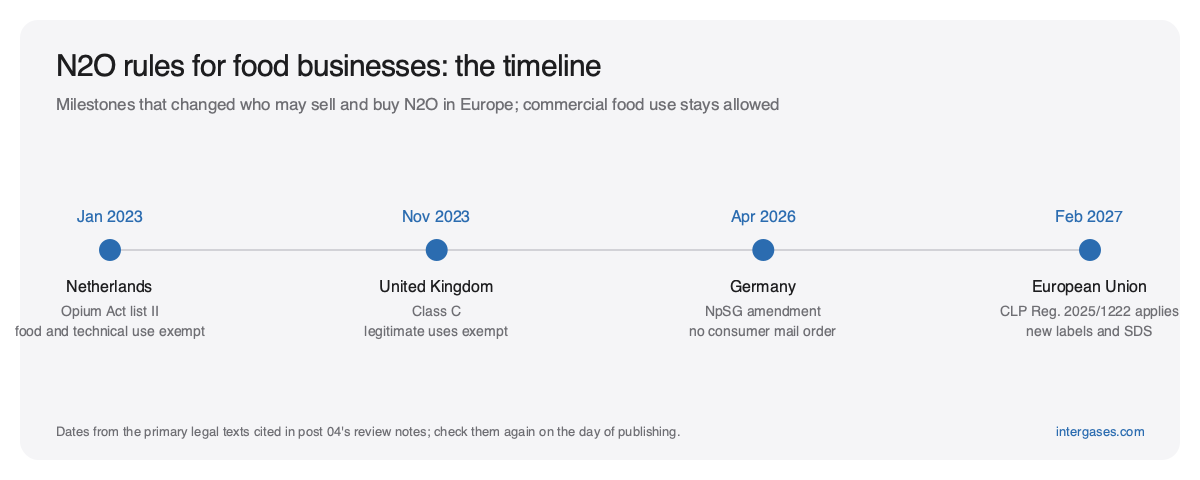
- Germany restricted N2O from 12 April 2026, including a ban on mail-order and vending-machine sales.
- The EU reclassified N2O as toxic for reproduction (category 1B). The new classification applies from 1 February 2027, and a draft EU restriction would stop most supply to the general public from the same date.
What did not change: N2O remains an authorised food additive, E942, under the EU food additives regulation. Whipping cream and making espumas in a professional kitchen remain permitted in every country covered here; in Germany this rests on the commercial-use exemption.
Nitrous oxide regulations by country
| Country | Rule | Since | What it means for a food business |
|---|---|---|---|
| EU | CLP reclassification, Delegated Regulation (EU) 2025/1222 | Applies 1 Feb 2027 | New labels and safety data sheets; use unchanged |
| EU | Draft REACH Annex XVII restriction | Expected 1 Feb 2027 | Supply to the general public restricted; professional supply continues |
| Germany | NpSG amendment, BGBl. 2026 I Nr. 2 | 12 Apr 2026 | Commercial use exempt; no mail-order or vending-machine sales |
| Netherlands | Opium Act, List II | 1 Jan 2023 | Food-additive use exempt |
| France | Law no. 2026-798, Public Health Code art. L. 3611-3 | 19 Aug 2026 | Sale only to professional categories listed in a decree (pending); sellers must verify the buyer |
| United Kingdom | Class C, Misuse of Drugs Act 1971 | 8 Nov 2023 | Catering use lawful; records for suppliers |
| Poland | No N2O-specific national act confirmed | – | EU rules apply directly |
The sources are the official legal texts and government pages. For Poland, we could not confirm any national act specific to N2O at the time of writing (October 2026). A question about N2O sales was put to the Minister of Health in the Sejm in January 2026 (interpellation no. 14726). In its reply of 12 February 2026, the ministry stated that N2O is not on the Polish list of psychotropic and new psychoactive substances. The EU rules below apply in Poland as in every member state.
Germany: the NpSG amendment in detail
Germany added nitrous oxide to the New Psychoactive Substances Act (Neue-psychoaktive-Stoffe-Gesetz, NpSG). The amending law was published in the Federal Law Gazette as BGBl. 2026 I Nr. 2 and has been in force since 12 April 2026. N2O is listed by name in the new Annex 2, under its legal names “Distickstoffmonoxid” and “Lachgas” and as E 942.
According to the German NpSG text:
- Containers above 8.4 g. N2O packed in a container with more than 8.4 g of gas falls under the general prohibition in § 3(1) no. 1: trading, placing on the market, acquiring and possessing it are prohibited.
- Small containers. Selling more than ten containers of up to 8.4 g each in one sale is covered by the same prohibition.
- Mail order and vending machines. Trading N2O by mail order or through self-service vending machines is prohibited (§ 3(1) no. 2).
- Minors. Supplying N2O to persons under 18 is prohibited, and so is acquisition or possession by them.
The exemption that matters for food businesses is § 3(2) no. 1: uses recognised by the state of science and technology for commercial, industrial or scientific purposes are exempt. The law does not list which uses count. A restaurant or caterer that buys N2O as a food additive for its own kitchen should keep the evidence of that purpose: the business registration, the invoice made out to the company, and the purchase recorded in the books.
The EU timeline: CLP from February 2027 and the REACH restriction
CLP reclassification. Commission Delegated Regulation (EU) 2025/1222 amends the harmonised classification list of the CLP Regulation. Dinitrogen oxide receives a harmonised classification as toxic for reproduction, category 1B. The classification applies from 1 February 2027. For a kitchen this means:
- new labels on cylinders with the health-hazard pictogram and updated hazard statements,
- revised safety data sheets from your supplier,
- a reason to review where cylinders are stored and who handles them.
REACH restriction (draft). Substances classified as category 1B fall under entry 30 of REACH Annex XVII, which restricts their supply to the general public. The Commission’s draft regulation (document D(2026) 112095, sent to the Council on 9 July 2026 as Council document 11791/26 ADD 1) adds N2O to that list with a derogation for food-additive use. Under the draft, the general public could still buy:
- cartridges with a maximum of 18 g of N2O for use as a food additive, limited to 90 g per supply and to buyers aged 18 or over,
- aerosol cans of food, such as whipped cream, where N2O is the propellant,
- food prepared or packaged with N2O.
The draft keeps stricter national laws in place. According to the EU notification of the draft, the restriction would apply to N2O from 1 February 2027, the same day as the CLP classification. It is still a draft: the final text may change and adoption is not yet published in the Official Journal.
The practical effect for a food business: a cylinder holds far more than 18 g (a 2 kg cylinder holds 2,000 g), so from 2027 cylinders could only be supplied to professional users. Restaurants, caterers and bakeries are professional users. Buying through a business account becomes the normal route, not an extra step.
What counts as commercial use, and how Intergases verifies business customers
No law here defines one document that proves commercial use. In practice a supplier looks for three things:
- A registered business. A company or sole trader registration, ideally in the food sector.
- A valid EU VAT number. It can be checked in the EU VIES system. EU companies with a valid VAT number receive invoices without VAT.
- An invoice to the business. The purchase is booked as a business expense, which links the gas to the kitchen.
Intergases sells N2O only to business customers: restaurants, caterers, bakeries, bars, hotels and other food businesses. You open a business account, we check the company and its VAT number, and orders are invoiced to the company. Business customers also get volume prices from 4 cylinders. Safety data sheets are sent after purchase and are available on the documents page. National rules in the delivery country also apply; check them before you order.
E942 cylinders: storage and handling in a professional kitchen
E942 is the food additive number for nitrous oxide. The laws above treat packaging sizes differently: German law draws the line at 8.4 g per container, the draft EU restriction at 18 g per cartridge for supply to the public. A refillable steel cylinder is far above both thresholds, so it is regulated as a professional product. In a busy kitchen one cylinder also replaces hundreds of single-use cartridges, with less packaging waste.
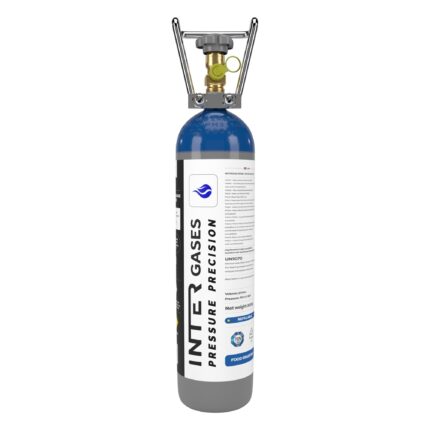
A cylinder never connects straight to a cream siphon. The 2 kg N2O E942 cylinder has a DIN 477 No. 6 valve and connects through a pressure regulator or filling adapter. Basic rules for a kitchen:
- Store cylinders upright and secured against falling, in a ventilated area away from heat sources and ovens.
- Keep the protective cap on when the cylinder is not in use, and check the tamper-proof seal on delivery.
- Use a regulator with a gauge and a safety valve; set the pressure the dispenser manufacturer specifies.
- Keep the safety data sheet where staff can find it; only trained staff handle cylinders.
The 2 kg cylinder is a TÜV-approved refillable steel cylinder. The 3.75 kg N2O E942 cylinder holds nearly twice the gas of the 2 kg size. Empty cylinders go back through the refill service rather than into waste. Our guide to N2O in professional kitchens covers set-up and sizing in detail.
The next 18 months: how to prepare
| When | What happens | What to do |
|---|---|---|
| Now | Germany, the Netherlands, France and the UK already restrict consumer sales | Buy only through a business account |
| By January 2027 | Suppliers update labels and safety data sheets | File the new safety data sheet |
| 1 February 2027 | CLP classification applies; REACH restriction expected | Expect business verification on every N2O order |
| 2027 onwards | Member states may add stricter national rules | Check national rules before ordering |
Keep your company documents ready, store invoices with your accounts, and move to refillable cylinders if you still rely on cartridges bought at retail. For the basics of E290 and E942 gases, see our guide to food grade gas cylinders.
FAQ
Can a restaurant still order N2O online?
Yes, as a business customer and where national law allows it. The new rules target sales to consumers and minors. In Germany, mail-order trade in N2O is prohibited under the NpSG, so German businesses should check how their supplier applies the commercial-use exemption.
What documents does a supplier need from a food business?
Usually a company registration, a valid EU VAT number and an invoice address for the business. Intergases checks the company and the VAT number when you open a business account, and EU companies with a valid VAT number receive invoices without VAT.
Do 8 g chargers fall under the same rules?
Not always. German law treats containers above 8.4 g and sales of more than ten small containers per sale differently from single small cartridges. The draft EU restriction would allow cartridges of up to 18 g for food use to be sold to adults, with a limit of 90 g per supply.
What changes in February 2027?
From 1 February 2027 N2O is classified as toxic for reproduction, category 1B, under Regulation (EU) 2025/1222, so labels and safety data sheets change. A draft REACH restriction expected from the same date would limit supply to the general public, while supply to professional users continues.