
ADR 1000-points calculator for gas cylinders (1.1.3.6)
Add the cylinders on your vehicle and you get the ADR points. Up to 1000 points per transport unit the exemption 1.1.3.6 applies: no orange plates and no ADR certificate for the driver. A transport document, a 2 kg fire extinguisher and secured cylinders are still required. Compressed gases count by water capacity in litres, liquefied gases by kg.
Calculate your load
ADR points on this transport unit
286 / 1000
1000 points or less: exemption 1.1.3.6 applies
Category 2: 66 points · Category 3: 220 points
714 points left: room for 14 more × 50 L Argon.
The points count per transport unit (vehicle plus trailer) and for everything on board. Under 1000 points the transport document must state the quantity and the calculated value for each transport category.
Please enter values within the stated range.
Cylinders for this
Filled cylinders shipped from our warehouse in Poland, buyable online.
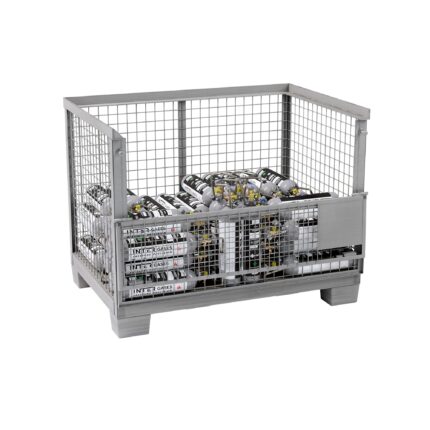 CO2 E290 Food Grade – 60 × 2 kg Cylinders in a GitterboxView product →
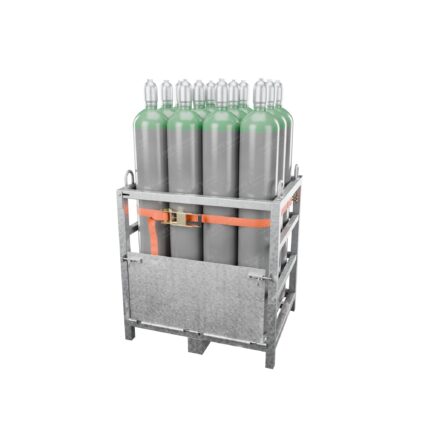 Argon 5.0 50 L – pallet of 12 cylinders incl. steel transport palletView product →
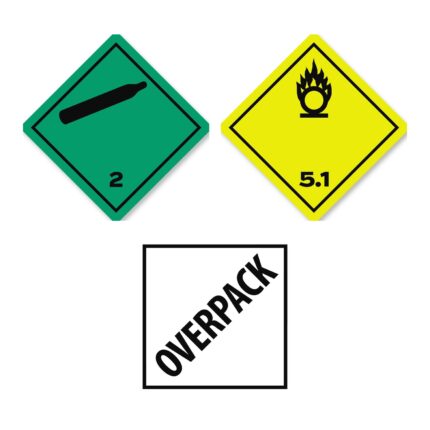 ADR Hazard Labels 2.2, 5.1 & Overpack – 10 × 10 cm, Self-adhesive FoilView product →
Shop by use: Welding gas cylinders
What still applies under 1000 points
1.1.3.6 is a partial exemption. These rules stay in force:
- Transport document on board (5.4.1): UN number, name, label, number of cylinders and quantity, plus the total quantity and points per transport category.
- One fire extinguisher of at least 2 kg dry powder for fire classes A, B and C, sealed, in date and within reach (8.1.4.2).
- Training for the driver and everyone who loads, with records (Chapter 1.3). No ADR certificate needed.
- Cylinders secured so they cannot roll or fall: lying lengthwise or crosswise and wedged, or upright in a rack (CV9, CV10). Valves closed, caps on.
- Ventilation: preferably an open or ventilated vehicle. In a closed van gas must not reach the cab, or the doors carry the warning “WARNING NO VENTILATION OPEN WITH CAUTION” (CV36).
- Approved, labelled cylinders within their test date (Chapter 5.2, P200).
- No smoking, no e-cigarettes and no naked flames during loading and unloading (8.3.5).
What full ADR adds over 1000 points
Over 1000 points, or with any category 0 good, these come on top:
- Orange plates at the front and rear (Chapter 5.3)
- ADR training certificate for the driver (8.2.1)
- Instructions in writing in the cab (5.4.3)
- Further vehicle equipment such as a wheel chock and warning signs (8.1.5), more extinguisher capacity (8.1.4.1)
- Tunnel restrictions by tunnel code (Chapter 8.6)
- No passengers besides the crew (8.3.1)
Points per gas cylinder
Common cylinders and how many fit under 1000 points when they are the only load.
| Gas | Cylinder | UN | Category | Points | Max. on one vehicle |
|---|---|---|---|---|---|
| Carbon dioxide (CO2) | 2 kg | 1013 | 3 | 2 | 500 |
| Carbon dioxide (CO2) | 10 kg | 1013 | 3 | 10 | 100 |
| Carbon dioxide (CO2) | 30 kg | 1013 | 3 | 30 | 33 |
| Nitrous oxide (N2O) | 2 kg | 1070 | 3 | 2 | 500 |
| Argon | 10 L | 1006 | 3 | 10 | 100 |
| Argon | 50 L | 1006 | 3 | 50 | 20 |
| Argon/CO2 welding mix | 20 L | 1956 | 3 | 20 | 50 |
| Oxygen | 50 L | 1072 | 3 | 50 | 20 |
| Nitrogen | 50 L | 1066 | 3 | 50 | 20 |
| Helium | 50 L | 1046 | 3 | 50 | 20 |
| Propane | 11 kg | 1978 | 2 | 33 | 30 |
| Propane | 33 kg | 1978 | 2 | 99 | 10 |
| Acetylene | 8 kg | 1001 | 2 | 24 | 41 |
| Hydrogen | 50 L | 1049 | 2 | 150 | 6 |
| Methane / natural gas (CNG) | 50 L | 1971 | 2 | 150 | 6 |
| Refrigerant R32 | 9 kg | 3252 | 2 | 27 | 37 |
| Refrigerant R134a | 12 kg | 3159 | 3 | 12 | 83 |
| Ammonia | 50 kg | 1005 | 1 | 1000 | 1 |
| Chlorine | 5 kg | 1017 | 1 | 100 | 10 |
| Carbon monoxide | 10 L | 1016 | 1 | 500 | 2 |
| Sulphur dioxide | 5 kg | 1079 | 1 | 250 | 4 |
| Empty cylinders (uncleaned) | – | – | 4 | 0 | unlimited |
Compressed gases count by water capacity whatever the pressure: a 50 L argon cylinder is 50 points at 200 or at 300 bar. Liquefied gases count by the gas in kg, not by the cylinder’s weight. Ammonia is a category 1 gas with the multiplier 20 (50 kg maximum).
ADR transport categories (1.1.3.6.3)
The transport category is in column 15 of ADR Table A. It sets the multiplier and the maximum quantity per transport unit.
| Category | Multiplier | Max. per transport unit | Gas examples |
|---|---|---|---|
| 0 | – | 0: no exemption | A few highly dangerous goods |
| 1 | × 50 (ammonia, chlorine × 20) | 20 kg or L (ammonia, chlorine 50 kg) | Ammonia, chlorine, Carbon monoxide, Hydrogen sulphide, Sulphur dioxide |
| 2 | × 3 | 333 kg or L | Propane, butane, LPG, acetylene, hydrogen, Methane / natural gas (CNG), Ethylene, Refrigerant R32 |
| 3 | × 1 | 1000 kg or L | CO2, argon, nitrogen, oxygen, helium, compressed air, welding mixes, Sulphur hexafluoride (SF6), Refrigerant R134a |
| 4 | not counted | unlimited | Empty uncleaned cylinders |
How the points are calculated
- Look up the transport category of each good (ADR Table A, column 15). Compressed gases count by the cylinder’s water capacity in litres, liquefied and dissolved gases by net mass in kg (1.1.3.6.3).
- Multiply: category 1 × 50, category 2 × 3, category 3 × 1. Category 4 is not counted (1.1.3.6.4).
- Add up everything on the transport unit. Up to 1000 the exemption 1.1.3.6 applies. With any category 0 good it never does.
Empty, uncleaned cylinders are category 4 even if they held a category 1 to 3 gas. Goods that are already exempt in another way (for example under 1.1.3.1 a or 1.1.3.2) are left out of the sum (1.1.3.6.5).
Sources: ADR 2025 (UNECE, ECE/TRANS/352, English edition): 1.1.3.1, 1.1.3.2, 1.1.3.6, Table A of 3.2.1, 5.4.1.1.1 (f), 7.5.11 CV9, CV10, CV36, 8.1.4.2 to 8.1.4.5, 8.3.5, 8.6.3.3. Status: October 2026.
Frequently asked questions
Each dangerous good is multiplied by the factor of its transport category (category 1 × 50, category 2 × 3, category 3 × 1) and everything on the vehicle is added up. At 1000 or less the partial exemption 1.1.3.6 applies: no orange plates, no ADR certificate for the driver, no instructions in writing and no tunnel restrictions.
It depends on the gas. CO2, argon, nitrogen, oxygen and helium are category 3, so 1000 points are 20 argon cylinders of 50 L or 100 CO2 cylinders of 10 kg. Propane, acetylene and hydrogen are category 2 (× 3): 30 propane cylinders of 11 kg. A mixed load is added up.
Compressed gases (argon, nitrogen, oxygen, helium, mixed gas, hydrogen) count by the cylinder’s water capacity in litres, whatever the filling pressure. Liquefied and dissolved gases (CO2, propane, butane, acetylene) count by the net mass of the gas in kg.
Empty, uncleaned cylinders are transport category 4 and are not counted. They are still dangerous goods: valves closed, caps on, labels left on and secured in the vehicle.
Private individuals carrying gas packaged for retail sale for their own household, leisure or sport are outside ADR altogether (1.1.3.1 a). Companies carrying gas for their own work can use 1.1.3.1 c: up to 450 L per packaging and within the 1000 points, but not for deliveries. Delivering gas to customers always falls under the 1000-point rule. In every case: secure the cylinders, close the valves and ventilate the car.
Embed this calculator
You may embed the calculator in blogs, forums and guides for free, without signing up. Please keep the credit line.
Guidance only, not legal advice. The current ADR text and your dangerous goods safety adviser have the last word.


