
Gas cylinder content calculator: how much gas is in your cylinder?
Gas content = water volume × filling pressure, corrected for real-gas behaviour. A 50-litre argon cylinder at 200 bar holds about 10.7 m³ of gas at 15 °C (m³ at 1 bar), which is about 17.9 kg.
Calculate the gas content
Gas content Argon
10.72 m³
≈ 17.89 kg
at 15 °C and 1 bar · 50 L · 200 bar · 15 °C
Real gas vs ideal gas
real vs ideal: +6.6 %For Argon at 200 bar and 15 °C the compressibility factor is Z = 0.937: more gas fits in than the rule of thumb says.
Please enter values within the stated range.
Cylinders for this
Filled cylinders shipped from our warehouse in Poland, buyable online.
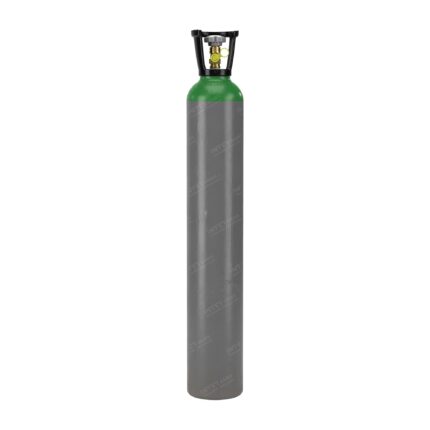 10 L Cylinder, 2.1 m³ @ 200 barArgon 5.0View product →
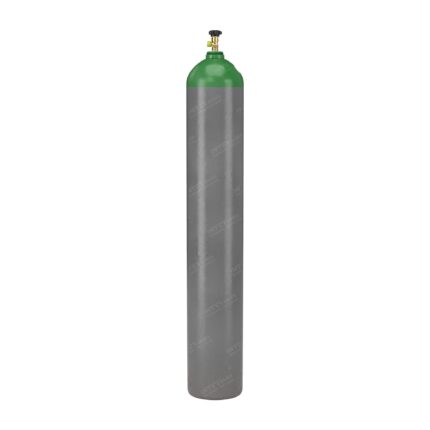 50 L Cylinder, 10.7 m³ @ 200 barArgon 5.0View product →ArgonAll sizes in the shopAll sizes →
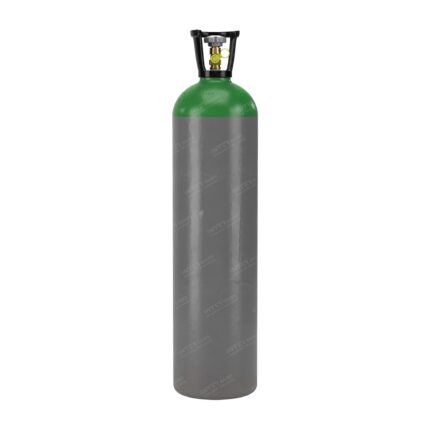 20 L Cylinder, 4.7 m³ @ 200 barArgon/CO2 82/18 MixView product →
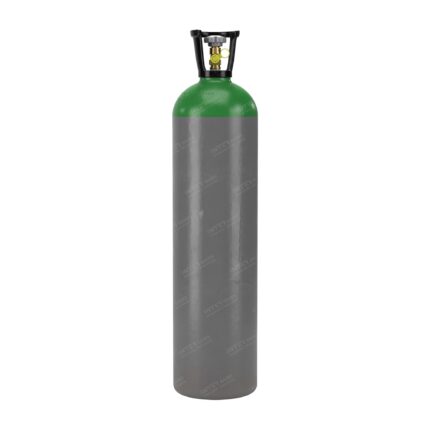 20 L Cylinder, 4.4 m³ @ 200 barArgon/CO2 92/8 Mix (M20)View product →
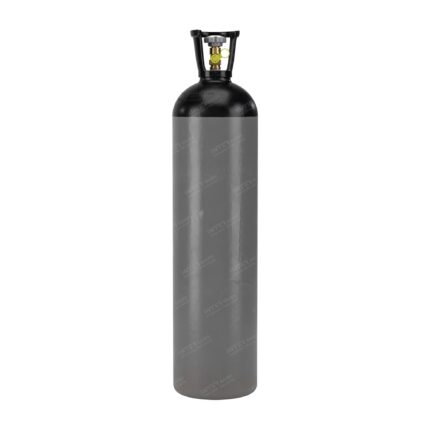 20 L Cylinder, 3.8 m³ @ 200 barNitrogen 5.0View product →NitrogenAll sizes in the shopAll sizes →
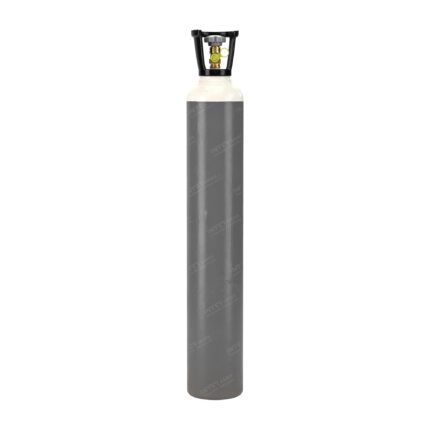 10 L Cylinder, 2.1 m³ @ 200 barTechnical OxygenView product →OxygenAll sizes in the shopAll sizes →
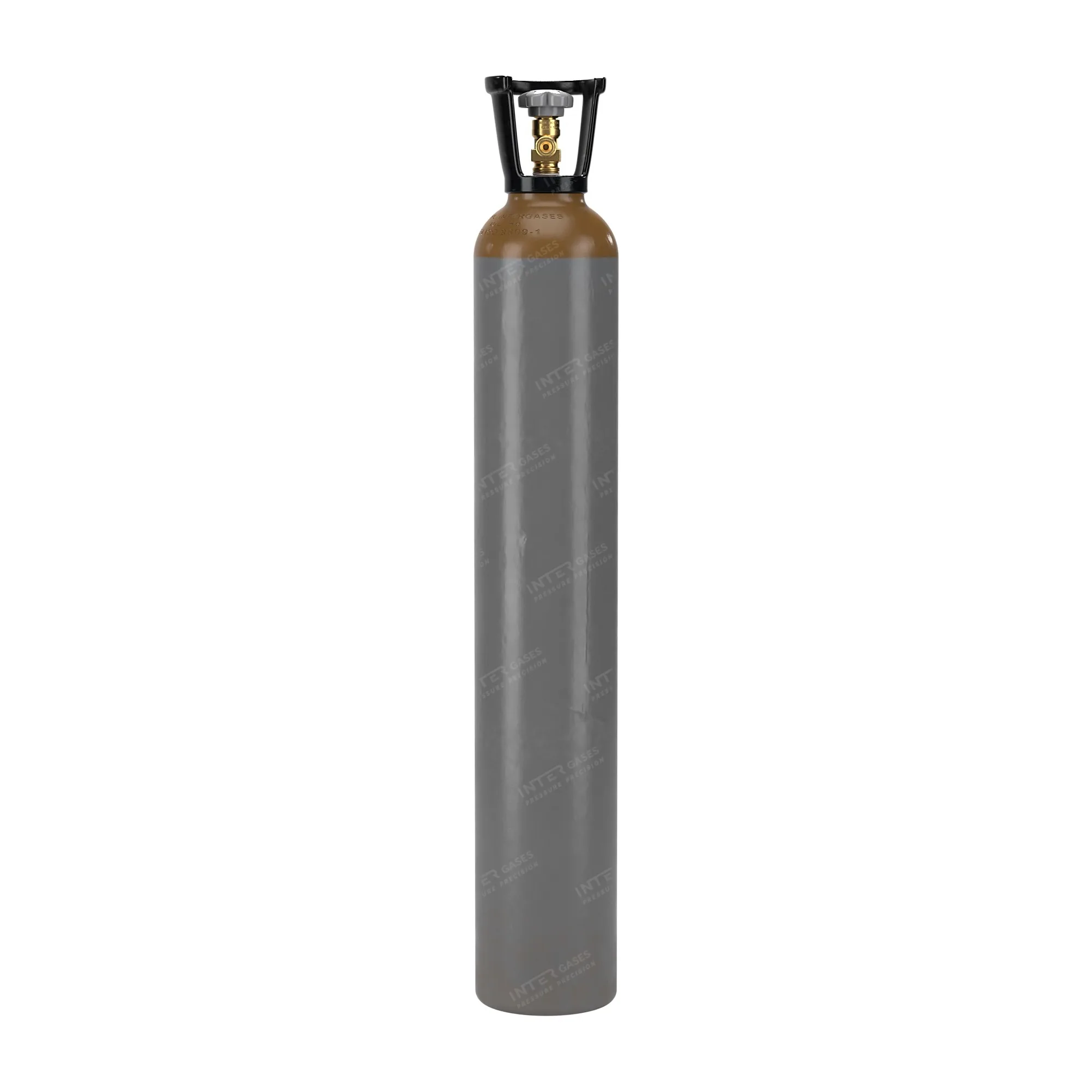 10 L Cylinder, 1.82 m³ @ 200 barHelium 4.0View product →HeliumAll sizes in the shopAll sizes →
Shop by use: Welding gas cylinders · Helium for balloons
How compressed gas fills a cylinder
Compressed gas always fills the whole cylinder. Higher pressure packs more molecules into the same space, so the gas gets denser and the gauge climbs. The figure follows your inputs in the calculator above.

Argon, nitrogen, oxygen and helium stay gaseous at room temperature however high the pressure; they only get denser. Liquefied gases such as CO2 behave differently: see the filling ratio calculator and the phase diagram.
How we calculate
- The gauge shows overpressure, so we add 1.01325 bar of atmospheric pressure.
- Density in the cylinder: ρ = p · M ÷ (Z · R · T). We tabulated Z for each gas from 0 to 320 bar and −20 to +50 °C with CoolProp 8.0.0 (reference equations of state) and interpolate between the grid points: within 0.02 % of CoolProp at 378 check points. The argon/CO2 mixes are computed as real mixtures.
- Mass = density × water volume. m³ = mass ÷ gas density at 15 °C and 1 bar, the reference used in Linde’s datasheets. Referred to 1.01325 bar it would be about 1.3 % fewer m³.
- For comparison, the ideal gas law (Z = 1) with the same reference.
- We show the total content; the residual pressure left in the cylinder is not deducted.
For comparison: Linde lists about 10.7 m³ of argon, 9.53 m³ of nitrogen and 9.13 m³ of helium for a 50-litre cylinder at 200 bar; the calculator gives 10.72, 9.58 and 9.16 m³ at 15 °C.
Sources: real-gas data CoolProp 8.0.0, HEOS equations of state (I. H. Bell, J. Wronski, S. Quoilin, V. Lemort, Ind. Eng. Chem. Res. 53 (2014) 2498–2508); R = 8.314462618 J/(mol·K) (CODATA 2018); comparison figures and the 15 °C / 1 bar reference: Linde product datasheets Argon 5.0 (Linde Gas GmbH Austria, 14 Oct 2025), Stickstoff 5.0 (27 Nov 2019), Helium 4.6 (7 Aug 2017).
Frequently asked questions
At 15 °C about 10.7 m³ of argon (17.9 kg), 9.6 m³ of nitrogen (11.2 kg) or 9.2 m³ of helium (1.5 kg), each as m³ at 15 °C and 1 bar.
That rule of thumb holds only for an ideal gas. 50 litres × 200 bar gives about 10 m³; at 15 °C the real figure is 10.72 m³ for argon but only 9.16 m³ for helium. At 300 bar nitrogen is already about 12 % below the rule of thumb.
The space the gas would take up once released at 15 °C and 1 bar. Linde’s datasheets state cylinder contents the same way. Referred to 1.01325 bar the figure is about 1.3 % lower.
The cylinder’s temperature when you read the gauge. A cylinder that stood in the sun shows a higher pressure but does not contain more gas.
No. Both are liquid in the cylinder at room temperature, so the pressure stays at the vapour pressure whatever the amount (CO2 at 15 °C about 50 bar, from CoolProp). They are filled by weight; the maximum is in the filling ratio calculator.
Embed this calculator
You may embed the calculator in blogs, forums and guides for free, without signing up. Please keep the credit line.
Values are guidance. The cylinder’s markings and the ADR govern.


